We take our food so much for granted. For many of us who lead hectic lives, food is something that necessary to tickle our taste buds and quell the hunger pangs. Why should people bring in climate change and animal welfare into it?
Daana has been changing this, in our own small way, by providing you with information about the farmer, the region, the season of harvest, and the methods they use to grow their crops. So you know what it took for that packet of rice/aata/dal or Oil to reach your home.
Daana brings you SINGLE ORIGIN, 100% ORGANIC food products from small and marginal farmers, grown with utmost care and ecological responsibility. SINGLE ORIGIN means that all the grains of that particular stock come from a single farm, belonging to an unblended heirloom variety with its unique texture, aroma and taste.
This is unlike other products that are aggregated over multiple harvests, and multiple hybridised sources.
You can trace our produce from your dinner table back to the family that grew it. For instance, our Toor Daal was grown by Bhaskar and Lakshmi, on their 5 acre farm in Metalkunta, Telangana. They use heirloom seeds passed down in their family for generations. Their farm is entirely rain-fed. No groundwater depleting borewells here. It has a very distinct, texture and taste that can only be experienced.
Daana’s products are now available all across India. Order from www.daana.in or call +91-9177882260
China, India, Mexico, Uganda have the most number of organic farmers. The data is mostly from buyers and certifying agencies. India has a large number of uncertified farmers largely due to the costs of certification. The number could actually be larger.
The Government is gearing up to approve the cultivation of Genetically Modified (GM) mustard any day now, which has obtained a regulatory clearance on May 11th 2017.Soon, mustard oil and mustard seed tadka in our food could harm us. Once GM Mustard is approved, it will open the floodgates for many more GM food crops – maize, rice, jowar, wheat, brinjal, bhindi, groundnut and so on. Click on the link below to sign this petition:
This engaging and informative guide will teach you how to cultivate and eat pulses, and why this is beneficial for everyone, including the planet.
Dan Jason is a farmer from Salt Spring Island, British Columbia. He recently published a book called “The Power of Pulses: Saving the World with Peas, Beans, Chickpeas, Favas & Lentils,” in which he makes a compelling argument for pulses being the food of the future and the answer to climate change-related concerns about food security.
Bichappa and his family have been practising organic farming for more than 45 years. His crops are entirely rain-fed. They use heirloom seeds which have been passed from generation to generation within their family.
Urad Dal (Blackgram) is a very nutritious lentil, and grows abundantly in the Deccan Plateau. It needs very little water to grow. Being a legume, it makes the soil richer and healthier to grow other things after its harvest. Most dals are used as natural fertilisers by organic farmers to nourish the soil.
Yaovan’s family has been practising organic farming for generations. A traditional rigorous form of inter-cropping, crop rotation and using hardy heirloom seeds ensures soil fertility, and minimises pest attack.
“Rural Sustainability is a Prerequisite for Urban Sustainability,” Dr Rajendra Singh
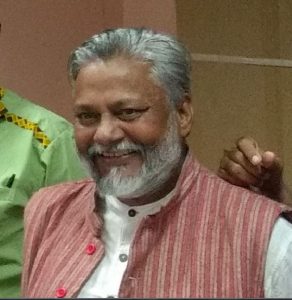
Dr Rajendra Singh
Dr. Rajendra Singh -the Water Man of India needs no introduction. Honoured with the Stockholm Prize in 2015, for reviving the ancient dam technology in the Alwar district of Rajasthan in the 1980s to bring water to 1200 parched villages, Dr. Rajendra Singh has dedicated his entire life to water conservation. Relying on traditional knowledge, local material and the science of common sense, he leveraged community help to rejuvenate nine rivers and restore groundwater levels in Rajasthan.
The Ramon Magsaysay award winner in Hyderabad for a conference, spoke to Sujata C for Daana on the topic of urban-rural linkages, rural reform, permaculture and threats to agriculture. The conversation got off with a few comments on negotiating the long, winding concrete vines of flyovers, metro lines and the chaotic Hyderabad traffic leading to the obvious question of urban sustainability. Here is the edited interview:
On urban sustainability:
“When the villagers are forced to migrate to cities due to helplessness and hopelessness then cities cannot be healthy. Cities depend on agriculture for their food. Their food comes from the villages. If our rural areas are not healthy, the city can’t be healthy. If the rural areas are not sustainable the Indian city can’t be sustainable. If we want our villages to be self reliant, we have to make them sustainable, the water in the village, the soil, the seeds, the hard work of the farmers, everything is included in this. Without the sustainability of our villages, urban sustainability is not possible.
The way our cities are growing with metros, high-rise buildings and heavy traffic, it is not at all sustainable. The basic necessities of a city come from villages and the cost of transporting to the cities these add to the burden of public health. And the pollution that we create in the process, these put a question mark on the way our cities are growing. The public health of the cities is linked to rural health. To correct all these we have to take the route of sustainable development.
On the link between rural reform and permaculture
The meaning of permaculture is to give respect and love for everything that exists in nature. Our love and respect for agriculture will come when we stop using chemical fertilisers, herbicides to cultivate our food. The name permaculture itself means giving respect to nature as it is while growing our food. The viability of permaculture depends on the fact that there is no contract farming done in our country. It should be a contract farming free country. The biggest threat to permaculture comes from contract farming. The trend of corporate farming will not allow permaculture to grow. They will use any term for their farming – chemical free farming, natural farming, zero budget farming, they will come up with a thousand names, but in reality they will be doing business. This will be very dangerous for our agriculture.
Agriculture is the foundation of Indian life. It is not a business. It is our cultural heritage, our ‘sanskriti’, it is not our business. Agriculture is the bridge between nature and the needs of human lives. Contract farming and corporate farming is going to break this bridge, because the stakeholders will only be interested in profits. They will not be interested in the culture that envelops agriculture. There will be no love for agriculture in contract farming. Those involved will want to grow stuff that brings in more money.
On the culture of agriculture:
It is my belief that if we are talking about agriculture, we have to examine its foundational principle. We have to examine our soil, our ‘bhoo sanskriti,’ its diversity and its potential to grow food that is good for us, good for the soil and the earth. When my soil health, my water health and the health of my land is good, then I will be good. To keep this chain of good health active, permaculture is the entry point, he concludes.
Viewed in the context of the farmers’ march, the intuitive advice from Dr. Rajendra Singh can tackle present day farmers’ woes and will continue to remain relevant in the times to come.
Daana supports the cause of sustainable development by supporting small and marginal farmers who grow food without pesticides.
A woman is like a tea bag. Put her in hot water and you will see how strong she is. We have all heard this one at some point. Time and again women have shown that they are adept at managing home, hearth and work with equal ease.
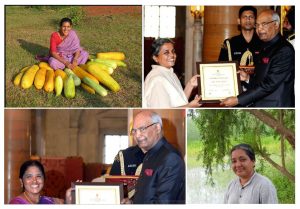
This year Nari Shakti Puraskar was given to 38 women. Notable among these are the All India Millet Sisters Network, Deepika Kundaji, Vanastree and Sabarmati Tiki. All of them are working in rural areas, with women in agriculture, promoting neglected grains and traditional seeds.
The Hyderabad based All India Millet Sisters Network (AIMS) is the first of its kind women millet farmers in the country that is dedicated to the cause of the neglected coarse grain. Millets are a traditional crop in the country and this network has brought together women farmers who are cultivating and conserving millets. It was set up eight years ago with 100 women. Today, it is a network of 5000 women across the country.
The story of Anjamma is an interesting one. She is a poor farmer from Telengana. She preserves seeds in a traditional way without using any chemicals. She stores seeds for next season in a cane basket, using easily available ash and neem leaves and seals them with cow dung and mud. Despite a drought spell and zero rainfall she reaped eight quintals millet and six quintals of toor dal from her bio diverse farm. Her work in keeping alive a traditional knowledge system in the preservation of seeds was recognised by Protection of Plant Varieties and Farmers Rights Authority, India (PPVFRA).
There are many stories like this one and they are getting noticed by none other than the Minister for Women and Child Welfare, Maneka Gandhi who is an environmentalist herself and rooting for women farmers. Read about the rest here in her own words.
Sujata C
Daana salutes all the women engaged in farming and seed preservation.